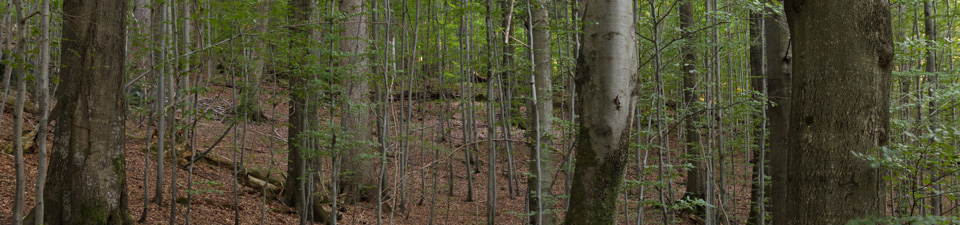
Knieja Czatożańska Nature Reserve, Poland
Knieja Czatożańska (57 ha) is part of Babia Góra National Park and is situated on gentle slopes facing north to northeast at elevations ranging from 810 m to 1090 m. Many steep stream valleys cut through the reserve. Average annual temperature is 5°C and annual precipitation 1200 mm, with the maximum in June and July; the bedrock is mainly formed by sandstones1.
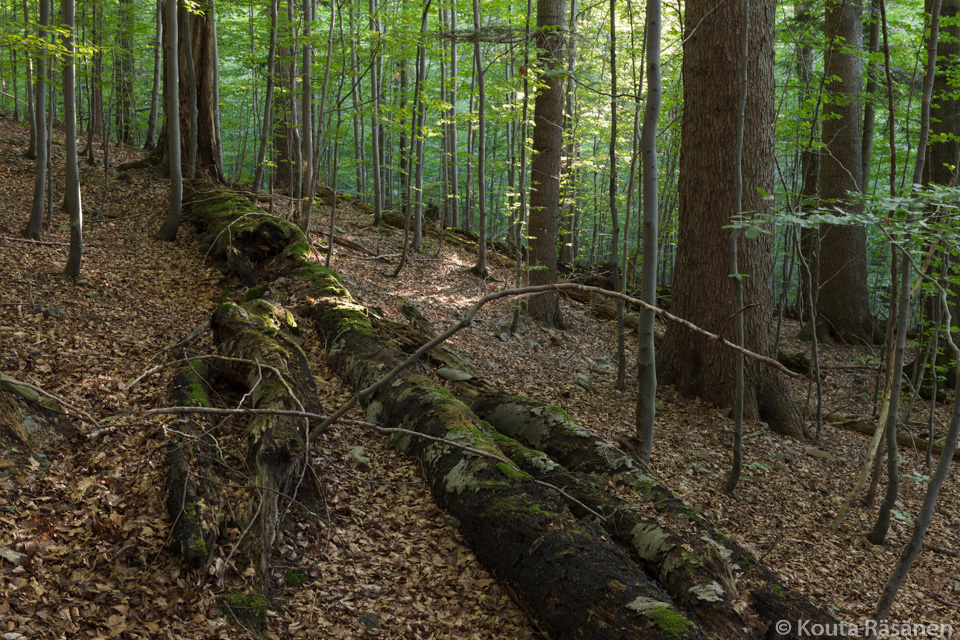
Knieja Czatożańska bears no signs of direct human activity, with the exception of study plot markings. Plenty of trees were felled by storm(s?), with abundant decaying logs lying on the ground, many conifers having broken crowns and dense young European beech (Fagus sylvatica) forest filling the gaps (photo below).
European beech is the most common tree species, followed by European silver fir (Abies alba). Norway spruce (Picea abies) is also relatively common, though many spruce trees have recently been killed by European spruce bark beetle (Ips typographus). Sycamore maple (Acer pseudoplatanus) is rather rare. Large conifers may grow in groups at some sites, otherwise here and there within beech forest. The tallest and largest fir trees are about 50 m tall with girths of over 4 m. There apparently are no spruce trees (anymore?) that are that tall or large.
The regeneration of fir and maple consists largely of small seedlings only, but due to the steep stream valleys, there are sites that are difficult for deer to access, and such sites may have dense, healthy fir regeneration. Spruce also regenerates, albeit to a much lesser extent than beech.
Due to the north-facing slope and the dense young beech, the forest floor is dark with only sparse undergrowth. The most abundant undergrowth plant is wood-sorrel (Oxalis acetosella). Other abundant plant species include wood ferns (Dryopteris spp.), sweet woodruff (Galium odoratum), blackberry (Rubus hirtus), coralroot bittercress (Cardamine bulbifera), Cardamine glanduligera, purple lettuce (Prenanthes purpurea) and bilberry (Vaccinium myrtillus). Knieja Czatożańska also features numerous springs and some small wet meadows. These wet sites have more luxuriant undergrowth.
Knieja Czatożańska is otherwise very quiet, but flights departing from Kraków and heading south take off over the reserve.
KR
References:
- Jaworski, A. & Paluch. J. (2002): Factors Affecting the Basal Area Increment of the Primeval Forests in the Babia Góra National Park, Southern Poland. Forstw. Cbl. 121, 97-108.