Borov Vrh Old-Growth Forest, Croatia
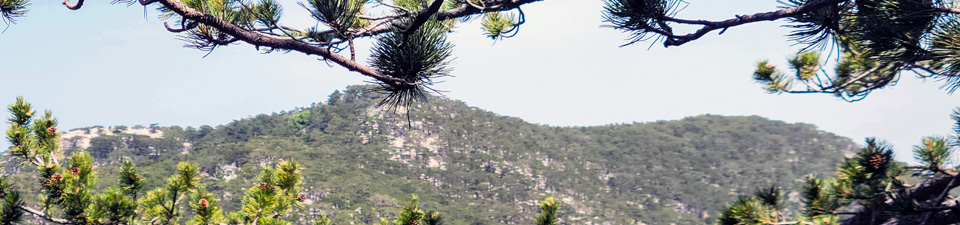
Ancient human influence on European woodlands has resulted in the extinction of many forest types which have become exceedingly rare in their pristine form, if not nonexistent. The Balkan peninsula, due to its remoteness and late industrialization, still contains perhaps the last great wildernesses of Europe aside from the Caucasus, Russia and Fennoscandia. Even though the once vast old-growth forests here were mostly logged in just the past century or two, the current state of logging is a destructive profit-driven practice throughout the region. Despite the political corruption that has assaulted many great forests in southeastern Europe, there are still unique protected ecosystems which can be found nowhere else on Earth. One of the greatest remaining examples of such an oasis can be found on the coastal slopes of the Velebit Mountain, where large forests of virgin black pine (Pinus nigra) still grow undisturbed.
Most of these pine groves are protected in both the Northern Velebit National Park and Paklenica National Park and are partially included in a World Heritage site called “Ancient and Primeval Beech Forests of the Carpathians and Other Regions of Europe”. This type of pine forest is considered a relic in today’s world, once being far more widespread. In Northern Velebit National Park these trees occupy elevations from nearly sea level all the way up to around 1200 m. There is more than one area of primeval pine forest in the park, but the site described here is a large complex known as “Borov Vrh” or “Pine Peak”. There are no trails to this forest area. To visit the location, one will need to find a guide from the Velebit Nature Park or Northern Velebit National Park.
Around Borov Vrh, at elevations of 800–1100 m, ancient pines cover valleys, slopes, and ridgetops with each of these areas developing trees of different characteristics. Average annual temperatures are above 7oC and average annual precipitation exceeds 1500 mm. The soil varies from relatively deep to almost completely rocky, with some ridges composed of sheer cliffs. The warmer and less humid climate creates an entirely different world than the cooler and wetter forests found only several kilometers deeper into the mountains.
Despite the well-preserved state of the Borov Vrh and the lack of logging in the area, there are remnants of important cultural and historical sites near one side of the virgin forest’s border. Throughout parts of Velebit, there are numerous ruins and abandoned settlements. These are remains of mostly seasonal dwellings by the nomads of Velebit who would wander up or down the mountain in yearly migrations. A few of these dwellings were quite extensive, with permanent residences where families lived. These traces of humanity, although completely abandoned as miniature ghost towns, are of tremendous value as cultural remnants of indigenous Croatian life. From old wells, walls, and even entire houses still standing in a state of decay, it is fascinating to observe the processes of forest regeneration here as young trees emerge from cracks between the stones. The weight of time is heavy upon the observer, and the endless cycle of decay and regeneration acts as a reminder of the impermanence of all things. Even today, some native inhabitants of Velebit are known to climb up and down the entire mountain in one day without much difficulty, easily overcoming more than 1500 m of elevation change. The main use for the pines was to produce “Paklina”, or pine resin, which was used as an ointment for injuries, fuel for torches, as well as a coating to aid in construction of wooden boats. The trees were not used for firewood or construction, which explains why human influence in the virgin forest itself is non-existant aside from a few pines on the edges which have scars where resin was once extracted.
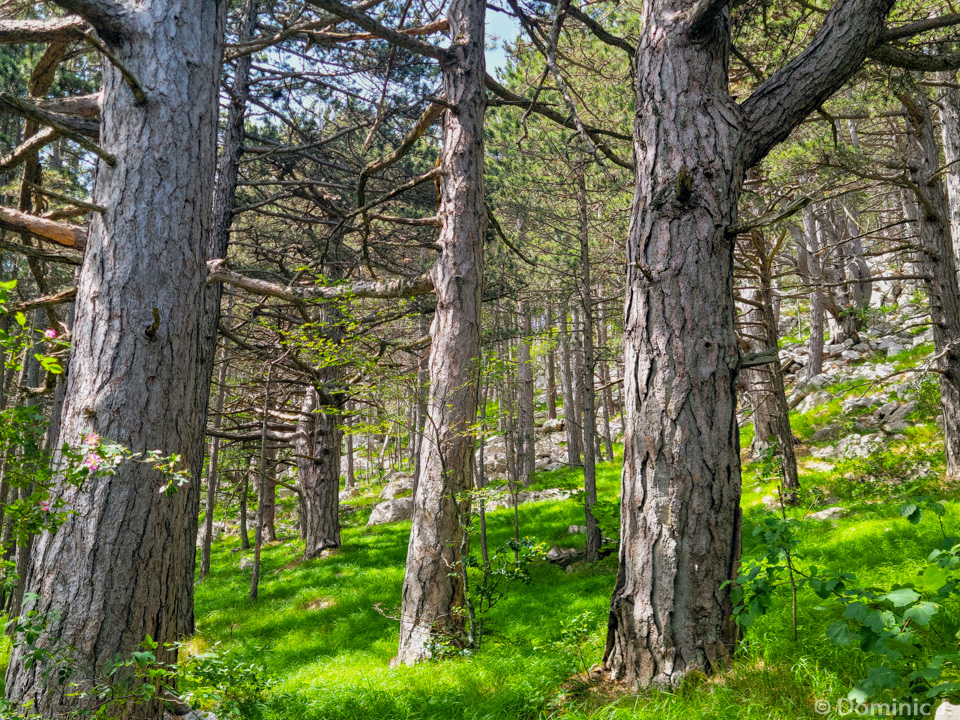
Almost pure black pine forests are especially open and spacious, with both tall, straight trunked trees as well as twisted and stunted specimens depending on the locality. The striking tones of bright reddish trunks and carpets of deep green grass are only broken by outcrops of stark white cliffs. Due to the relatively open forest floor, walking through these ancient groves is easy as in a park. The incredibly dense and complex crowns of trees are a stunning contrast to the open and airy expanses around their trunks which allow one to peer deep through the groves with unobstructed clarity. Canopy structures displayed by some of these pines are amongst the most unique of any members of their species found on Velebit. Shaped by mountain snow, Adriatic summer’s sun, and exposure to the strong “Bura” wind which roars down the coastal slopes of Velebit, groves of giant “Bonsai” trees are most pronounced on exposed locations. At exposed sites some large pines branch out into a canopy nearly 30 m wide no higher than 1–2 m from the ground. Forests on lower slopes and in sheltered valleys are cathedral-like, with trees like pillars forming a wide and dense canopy high off the ground with their horizontal branches. At favourable locations they may regularly exceed 1 m in diameter at breast height, though some individuals are notably larger. Some trees are over 30 m tall.
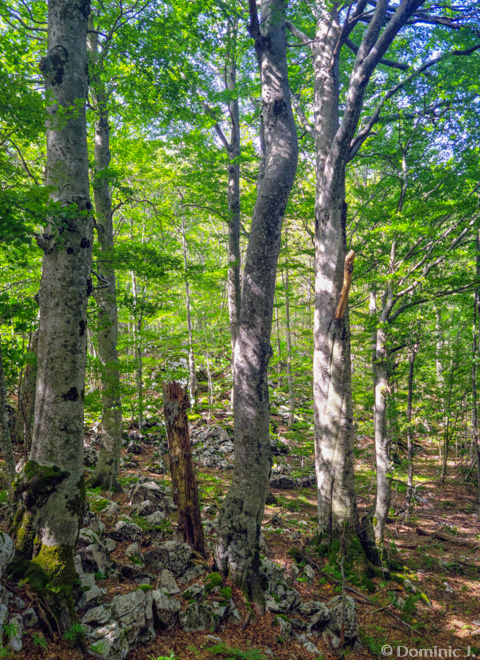
Generally, wind disturbances in the Borov Vrh area appear to be relatively rare despite exposure to the strong coastal winds, as the pines are shorter and rarely uprooted even by the most violent of storms. However, historical fires on these coastal slopes have occurred due to increasingly dry and hot summers, and they remain the most prevalent natural cause of disturbances at Borov Vrh. It is likely that pine regeneration has benefitted from these occasional historical fires, allowing the trees to form a pure forest and outcompete beech (Fagus sylvatica) growth throughout most of the area. Further into the continental side of the mountains fires become extremely rare and play little part in natural disturbances. At Borov Vrh, occasionally alternating with the pine forests depending on location and exposition are groves of old-growth beech (photo right), which cover smaller areas when compared to their coniferous counterpart. However, the lush localities of these beech groves amongst a sea of pines offer a rarely seen diversity.
The largest beech trees are of imposing size, with many exceeding 330 cm in cbh (circumference breast height) and 35 m in height. One tree at the border of the virgin forest has a cbh of about 480 cm and is characterized by a massive horizontal branch or reiterated stem. This branch could indicate the tree began its growth near a clearing, which may have allowed it to grow wider and shorter. However, there are many other beech trees which are only slightly smaller and are clearly forest grown, with tall, straight trunks.
Borov Vrh forest is highly important for understanding both the species distribution and climatic history of the region. Its remoteness, preservation and diversity of environments are only overshadowed by its uniqueness. As one of the last undisturbed coastal black pine forests in the world, it offers a rare glimpse into a mostly forgotten environment.
DJ
Reference: