Baniska Nature Reserve, Poland
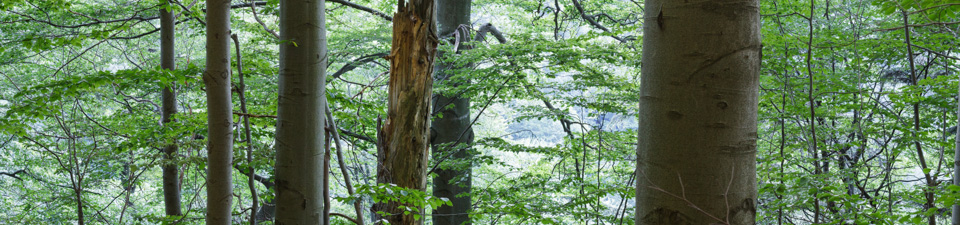
Baniska Nature Reserve was established in 1916 but the area was already protected by Count Adam Stadnicki in 1905. At that time, it covered only 18 ha. In 1983, Baniska was enlarged to 56 ha; most of it consists of virgin forest, but the forest at the highest elevations appears younger. In 2007, Baniska was enlarged once again to 142 ha to include the entire valley, which runs north–south; this newest part of the reserve is definitely not virgin forest. The virgin forest is located at elevations ranging from 775 to about 900 m. The bedrock is formed by sandstones and shales1.
The best parts of Baniska bear no signs of direct human activity like stumps, cut trees, logging trails, under-planting or simplified stand structure; however, an over-density of ungulate populations can be considered as an indirect effect2.
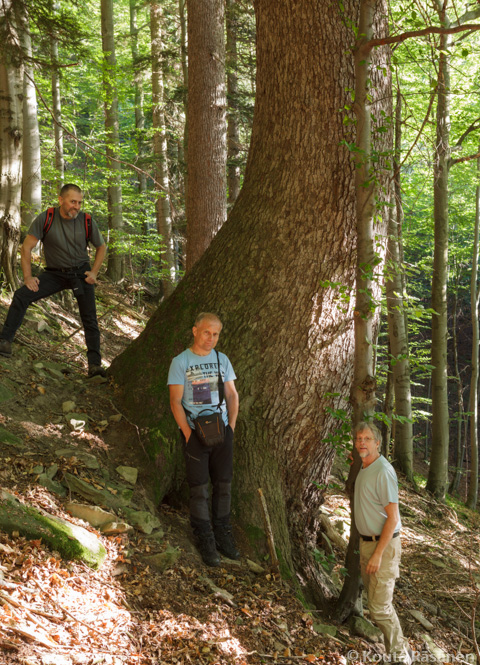
European beech (Fagus sylvatica) is the most common tree species, followed by European silver fir (Abies alba). Norway spruce (Picea abies) and sycamore maple (Acer pseudoplatanus) occur only sporadically. The tranquil Baniska Reserve is home to numerous large trees. The tallest fir is 55.3 m tall and the thickest has a girth of 521 cm 3. The latter has a leaning base and grows on the west-facing slope (photo right). Beech shows abundant regeneration, while regeneration of fir and maple consists only of small seedlings, the larger ones being likely browsed by deer.
The undergrowth is relatively species-rich for a beech–fir forest but quite sparse. The most abundant understory plant is wood-sorrel (Oxalis acetosella). Others common plants include lady fern (Athyrium filix-femina), broad buckler-fern (Dryopteris dilatata), male fern (D. filix-mas), sweet woodruff (Galium odoratum), yellow archangel (Lamium galeobdolon), glutinous sage(Salvia glutinosa), blackberry (Rubus hirtus), coralroot bittercress(Cardamine bulbifera), Cardamine glanduligera and touch-me-not balsam(Impatiens noli-tangere).
KR
References:
- Paluch, J. (2021): The stochastic backward shifts model better corresponds to the fine-scale structural heterogeneity of old-growth Abies-Fagus-Picea forests than the ontogenic life cycle model. Forest Ecology and Management 484.
- Paluch, J. et al. (2015): Spatial variability of close-to-primeval Fagus–Abies–Picea forests in the Western Carpathians (Central Europe): a step towards a generalised pattern. Eur J Forest Res 134: 235–246.
- https://www.monumentaltrees.com/en/