
Nadžak Bilo Old Growth Forest Reserve, Croatia
Croatia’s largest mountain range, Velebit, contains some of the country’s most fantastic montane old growth forest remnants. Among these virgin forests and reserves, most of which exceed 50 hectares in area and some which comprise over a thousand, Nadžak Bilo covers only about 18 ha. It is also situated by a high and seemingly exposed ridge. How then, has this unique yet small forest reserve produced not only one of Croatia’s greatest big tree groves, but also one of Europe’s? Despite the reserve’s size, Nadžak Bilo contains a great concentration of very large trees, as well as two giant record-breaking specimens. It seems there is no record of why Nadžak Bilo Reserve was created or even when, but it is likely used as a protected forest for research due to its old composition. Nadžak Bilo is an example of how magnificent groves and record trees can be hidden in some of the most remote and seemingly unassuming sites, and it is particularly interesting for studying the generational cycles of virgin forests.
The primary old growth forest of Nadžak Bilo comprises several very large sinkholes, slopes, as well as ridges located amongst high peaks above the Krasno Valley. Although the virgin forest is not very large it is quite remote, and displays a strong feeling of wilderness. The sinkholes are large enough to function as small valleys in how they influence forest composition, creating a diversity of environments. Within their confines there is deeper soil, greater humidity, and better shelter compared to the surrounding peaks and ridges. This is evident from the lush fern and butterbur (Petasites spp.) undergrowth as well as the moss cover. Because of the topography, highly productive groves of tall trees can be found below ridgetops with short and stunted trees, creating a great contrast. The virgin forest has no signs of human influence aside from research marks and is located at elevations of approx. 1300–1400 m. Climate data from other comparable sites on Velebit would indicate an average annual temperatures at under 5oC, while average annual precipitation is over 2200 mm, maybe more. Although all ages of forest growth are present in the reserve, the shift from the late optimal and terminal stage to the regeneration stage is especially interesting. Certain groves of Nadžak Bilo have exceptionally large and old individual trees, which are also the largest and oldest surviving members of their generation. Immediately around these veteran trees, many of which are dead, there are clusters of young growth. When the last giant trees at such sites fall and fully decay, the young forest will leave absolutely no indication that larger trees grew there in the past. These generational dynamics show how deceiving forest compositions can be, and how current species prevalence and age structure are influenced by the past characteristics of the area. Studying such situations allows us to understand that human life is just a short glimpse into to the life cycle of a forest.
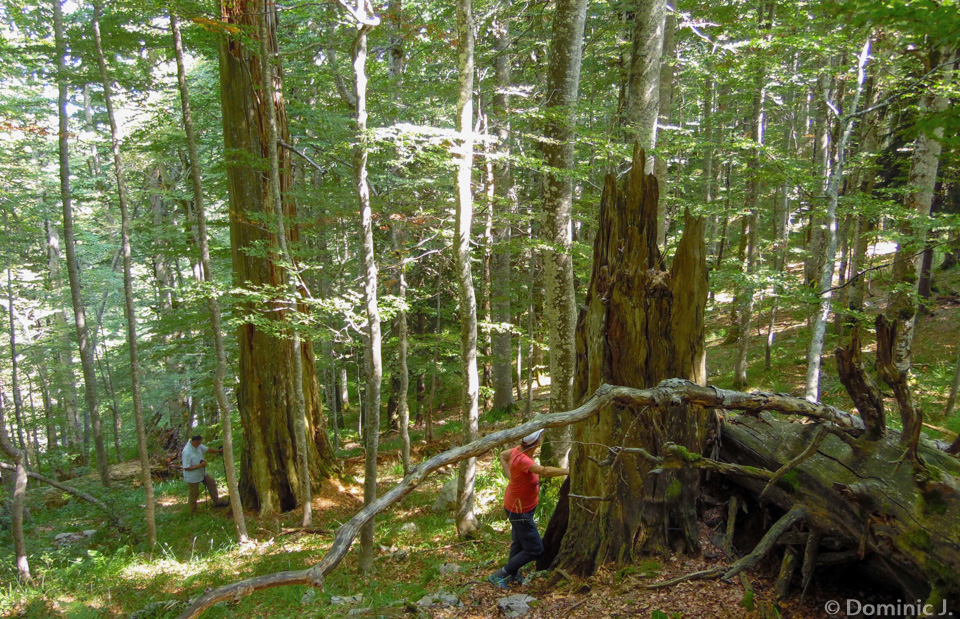
The most common trees in Nadžak Bilo are European beech (Fagus sylvatica), European silver fir (Abies alba), Norway spruce (Picea abies) and sycamore maple (Acer pseudoplatanus). All these tree species reach large sizes. Slopes face in all expositions, but northern is the most prominent. Typical of karst topography, there are rock monoliths and cliffs scattered throughout the forest. There is almost no scientific literature on the reserve, so the information presented in this report is directly from personal exploration, as well as from our guide who knows the forest well. To reach Nadžak Bilo, a guide should be found from Nature Park Velebit.
In well preserved mountain virgin forest reserves of Croatia, fir and spruce reach over 500 cm in cbh (circumference at breast height) and up to over 50 m in height. Reserves with favourable conditions comprise a great area, yet both the tallest and the largest conifers of Croatia’s virgin forests were found within view of one another in Nadžak Bilo’s 18 hectares of virgin forest. One research article claimed that Nadžak Bilo was home to a fir which exceeded 185 cm in diameter and over 500 years of age. However, other accounts claimed that this reserve did not in fact exist and was actually managed forest. Before visiting the real reserve, I had considered the possibility that the big fir tree was a misplaced record of the Tsar Fir or “Car Jela”. This tree grows in the same region of Velebit and it is claimed by some sources to be the largest fir in Europe. Truly, it is a giant tree with an almost taperless trunk, cbh of approx. 630 cm, estimated volume of approx. 60 m3, and a height of 48 m with a heavily damaged top, probably struck by lightning in the past. The age was estimated at about 500 years, and judging by the width of the trunk at the break, the former height was likely 55 m or more. However, when I finally visited Nadžak Bilo reserve, it became clear that there were other giants hiding in these mountains. The bumpy forestry roads and steep hikes lead to a seemingly insignificant ridge covered by small and stunted forest. And yet, upon reaching the ridgetop a vast depression revealed itself on the other side of the slope. There less than a hundred metres down into the sinkhole, stood a towering, imposing snag of mythical proportions which was one of the largest firs of Europe.

The fir of Nadžak Bilo is now dead, but when alive it was certainly the largest tree of Croatia’s montane old growth forests. It was clearly far larger than any other trees in Nadžak Bilo, some of which are also of great dimensions. The actual circumference measurements would have been larger than measured, since the tree is in a state of decay. Judging by what is left of the giant snag, as well as photos of the tree when alive, it was estimated at approx. 60 m3 in volume. Its height was never measured but other far younger firs in the reserve can exceed 45 m, so a tree of this age and size was likely well over 50 m tall. Our guide also remembers it as being among the taller trees of the stand, mentioning that a lightning strike is what began its decline. It even appears to be wider than the Tsar fir at approx. 700 cm in cbh, however this may be due to its position on a slope and the Tsar’s position on flat ground. The midslope cbh point of a tree growing on a steep slope is often measured slightly above the ground on the tree’s higher side. This seems to make the cbh of trees on slopes larger compared to trees on flat ground, even if they are of otherwise equal shape and trunk volume. When the cbh is measured from the highest ground level, it is about the same (over 630 cm) for both firs. Even when measured at 2 m above the mid-slope of the ground, the circumference is still nearly 600 cm. It is safe to say that the Tsar and Nadzak Bilo firs are the two largest trees of the Velebit mountain. Specimens of such size were probably not exceedingly rare in the historical expanses of the region and could be found from elevations of about 900 to 1400 m.
Where there is one giant tree there is often another. Just slightly lower on the same slope, a massive dark shape becomes visible, a trunk towering above the forest floor like a giant column with seemingly no end or sign of taper. However, looking high up through the canopy reveals it to be just half a tree, rather than a distant top scraping the sky. The spruce of Nadžak Bilo was likely the tallest native tree of Europe ever recorded. The tree is still alive, but its trunk is broken at around 35 m. The upper half lies next to the base and was measured to be unbroken for another 24 m all the way to the shattered top. Judging by the width of the trunk at the shatter, it was conservatively estimated to be at least 5 m taller by our experienced guide from Velebit Nature Park. He had observed the whole tree in the past and remembered it towering above all the other tall specimens nearby. This final estimate would result in a tree which would be at minimum 64 m tall, making it the tallest of its species on record as well as the tallest native tree of Europe! With a massive cbh of approx. 565 cm, and a trunk that is wider at 35 m than many other trees at breast height, it is unlike any other individuals of its species. Even when measured at 2 m above the mid-slope point it is still over 500 cm in circumference. The trunk volume is estimated to be well over 45 m3 before the break, which would make it the largest known spruce of Croatia, only potentially contested by the two largest specimens of Štirovača.
However, as this spruce’s trunk has broken and the true top was reduced to splinters, there is no way to confirm such precise measurements and find its exact height. Regardless, it is undoubtedly one of the tallest Norway spruce trees ever recorded, and certainly the tallest in Croatia. Immediately next to the spruce, there is yet another huge tree that survived being broken in half at nearly 30 m. Where it not for the gargantuan size of the record spruce and fir overshadowing it, a trunk this massive would have immediately stood out from the others. It is larger than the largest trees in many other virgin forests, with a cbh of 535 cm. Judging from the heights of the other trees and the trunk remnants, it was likely around 50 m tall and over 35 m3 in volume.
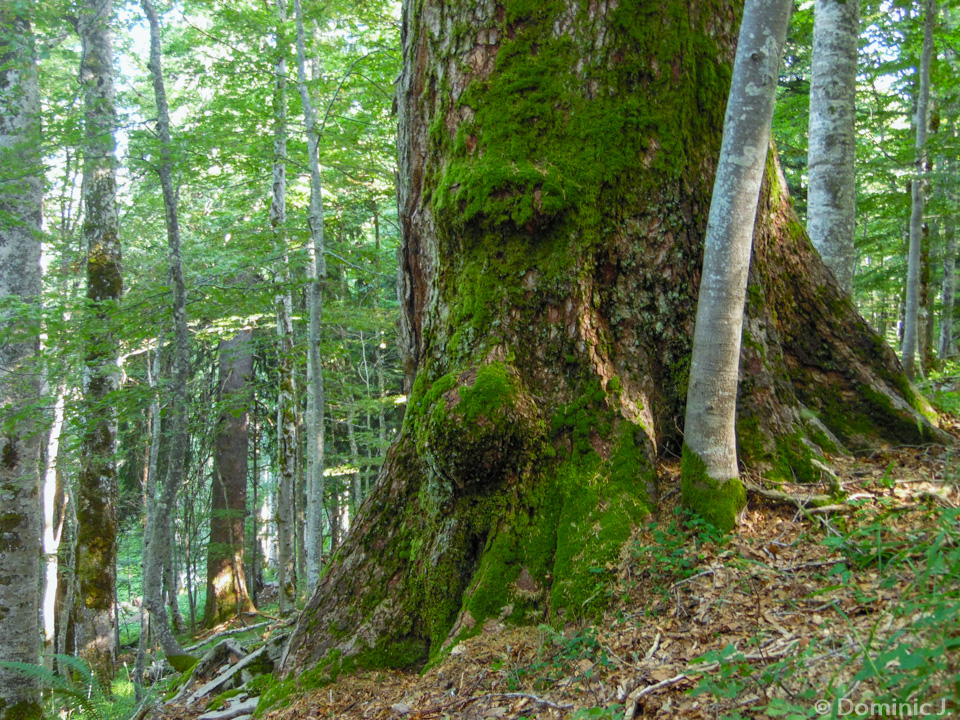
Aside from these giant trees, other relatively large fir and spruce of over 450 cm in cbh and approx. 45–50 m in height exist in the reserve. The surrounding beech groves are fantastic, and some trees are over 350 cm in cbh and 40 m in height. A few sycamore maples exceed 300 cm in cbh and 30 m in height. Nadžak Bilo does not have quite the species diversity or extensive groves of many other reserves due to its small size. However, its remote location near the peaks, contrast between ridges and sinkholes, preservation, record trees, and incredible scenery make it one of Croatia’s greatest forest reserves.
DJ
References:
https://repozitorij.sumfak.unizg.hr/islandora/object/sumfak%3A1750/datastream/PDF/view